


- Home/
- USHA x NDTV: From Uttar Pradesh To Bihar, Corporate Partnerships Drive Financial Freedom For Rural Women
USHA x NDTV: From Uttar Pradesh To Bihar, Corporate Partnerships Drive Financial Freedom For Rural Women
Team NDTV | Updated: December 26, 2025 17:05 IST
New Delhi:
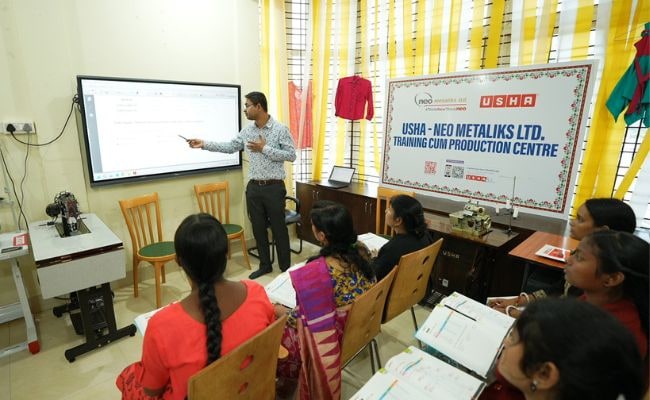
A sewing machine is quietly changing lives in rural India and giving women a chance to earn and stand on their own feet. This story highlights how Usha Silai School is working with purpose-driven companies to support women in rural India. From Uttar Pradesh to Bihar, the focus is on one goal: give women the skills and confidence to earn with dignity. The training covers sewing, tailoring, basic business knowledge and emotional resilience. With new income and respect at home, women are gaining agency, families are becoming more balanced and villages are seeing real progress.
New Model Of Shared Prosperity
Across India's villages, the centuries-old belief that a man must earn while a woman tends to the home is slowly being challenged. As skill training reaches deeper rural pockets, women are not only stepping into income generation but are also becoming decision-makers within their households. This change has been made possible through corporate and community partnerships that work to build empowerment at the grassroots. Usha International is among the organisations shaping this shift.
Why Tata Power Joined Hands With Usha
Tata Power partnered with Usha International to combine their strengths and create impact where it matters. Usha brings experience in sewing and women's skill training, while Tata Power supports with community reach and on-ground networks. Together, they have built a model that focuses not just on learning a craft, but on overall empowerment. Women are trained in tailoring, basic life skills, digital and financial literacy and emotional well-being. From Training To Enterprise The programme's model encourages continuity over dependency. Once a woman completes her training, she receives an Usha sewing machine and is supported to start a micro-business in her village. She then trains others, triggering a chain reaction that spreads across communities. It is something like an ever-expanding circle, where, if one woman trains five more, and those five train 10 each, the effect becomes exponential.
Ahimsa Bharti: Homemaker To Business Owner
In Uttar Pradesh, 33-year-old Ahimsa Bharti's life changed within months of joining a 20-day training programme. Earlier, she relied on her husband's income, which was never enough to run the household without conflict. Today, her home has become a sewing centre where she trains other women and takes in tailoring orders. She now earns between Rs 7,000 and Rs 8,000 a month. The financial independence has altered the dynamics inside her home. Earlier, she says, nobody paid attention to her opinions. Now, her mother-in-law consults her about household decisions, and relatives treat her with respect. She also held a summer camp for teenage girls, where 13 students learned basic stitching lessons. One of them dreams of starting her own brand someday.
CSR Framework Supports Continuity
The initiative runs under CSR, but it is built to continue even after funding ends. Tata Power provides local reach and infrastructure, while Usha supplies machines, training material, and ongoing support. Training is standardised and monitored, so progress can be tracked with data. Since 2022, 756 women have benefited from the Usha-Tata Power partnership. The goal is to add 1,000 to 2,000 more women every year without losing quality.
Bihar Joins In
Bihar is seeing similar momentum. Magadh Sugar & Energy Ltd., part of the KK Birla Group, has partnered with Usha International to support women living in sugar mill neighbourhoods. Their training programme runs for 25 days and focuses on helping women build home-based tailoring units. Company representatives say the decision to collaborate with Usha was driven by one factor: proof of impact. When women earn, the entire village participates in that progress.
A Social Shift
What stands out across these case studies is that the most powerful transformation is not financial, it is emotional and social. Women learn to speak up in family discussions, daughters see their mothers as role models and households that once dismissed the idea of women working now depend on them for stability.
Vision Grows Stronger
What began as short-term sewing training has expanded into a movement that is redefining what rural livelihoods can look like. From one woman easing her family's burden to hundreds standing independently and thousands planning for futures that were once unimaginable, the model is proving that development rooted in dignity is development that lasts. Corporate partnerships like these are not just building skills, they are building futures.
Published: December 26, 2025 16:58 IST
also read
Despite Nationwide Lockdown, People Employed In Health And Financial Sector Continue To Provide Services
Written by Ambika Singh KahmaHow Police Officers Are Battling The Crisis Of Coronavirus And Going Beyond The Call Of Duty
Written by Ambika Singh Kahma28-Year-Old From UP Donates Disability Pension Money To COVID-19 Fund, Urges Others To Help The Cause
PTI
 NDTV News Desk | Thursday April 02, 2020
Prime Minister Narendra Modi today announced a total lockdown in India from midnight for 21 days to fight the spread of coronavirus.
- NDTV News Desk | Friday April 03, 2020
India must also straight away allow internationally-recognized testing kits to be used here - these are already in use in the USA and Europe (do not delay by waiting for Indian clearance).
- Written by Garima Arora | Sunday April 12, 2020
Coronavirus outbreak: Take necessary precautions. Practise personal hygiene and social isolation. Utilise this time to do all the things you never found the time to do earlier. Here are some more tips to maintain your mental health by Psychiatrist Dr Sanjay Chugh
- NDTV News Desk | Thursday April 02, 2020
Hopefully, you are following social distancing and not mingling, especially with large groups or in crowded places. Can wearing a mask help? Here's what doctors say:
- NDTV News Desk | Thursday April 02, 2020
People across the world are worried about the rising cases of COVID-19, a highly contagious disease caused by the Novel Coronavirus that was first detected in China's Wuhan in December last year. What should you do if you're feeling any little ill, flu-ish and you are worried that you have symptoms of coronavirus?
- Edited by Deepshikha Ghosh | Thursday April 02, 2020
Coronavirus India: Airlines have been asked to ensure distance at check-in counters and enough space as passengers wait for their flights


