


- Home/
- Lifeline Originals | Oxygen Cylinders, Cancer, Soot: Inside Loni's Year-Round Air Crisis
Lifeline Originals | Oxygen Cylinders, Cancer, Soot: Inside Loni's Year-Round Air Crisis
Written by Sneha Mordani | Updated: November 12, 2026 19:06 IST
Sneha Mordani's ground report from Loni highlights a crisis beyond Delhi
Highlights
- Loni, Ghaziabad, recorded the world's highest annual PM2.5 level at 112.5 micrograms per cubic metre
- Pollution sources include industrial emissions, brick kilns, diesel vehicles, garbage, and road dust
- Residents report severe health issues, including cancer and respiratory problems linked to air quality
The dust was impossible to escape. It rose with every passing truck, hung over the narrow roads and settled on everything around us. By the time we left Loni, our clothes were covered in black soot. We could feel the dust particles in our mouths. We had spent just a few hours reporting from this town in Ghaziabad. For the people who live here, this is what everyday life looks like.
NDTV Lifeline's team had travelled to Loni a day after Diwali, when it was categorised among the world's most polluted cities, to understand what was making its air so toxic. What we found was an air pollution crisis that went far beyond firecrackers. Industrial emissions, brick kilns, diesel vehicles, garbage discharge and dust from broken roads have created an environment where residents say even breathing has become a struggle.
Loni's distinction as one of the world's most polluted cities is not new. According to IQAir's 2025 World Air Quality Report, Loni recorded an annual average PM2.5 concentration of 112.5 micrograms per cubic metre, making it the most polluted city in the world in that assessment. That is more than 22 times the World Health Organization's recommended annual guideline of 5 micrograms per cubic metre.
But the numbers tell only part of the story. We wanted to understand what was happening on the ground.
How was that a semi urban belt, more rural in the interiors had air like Delhi?
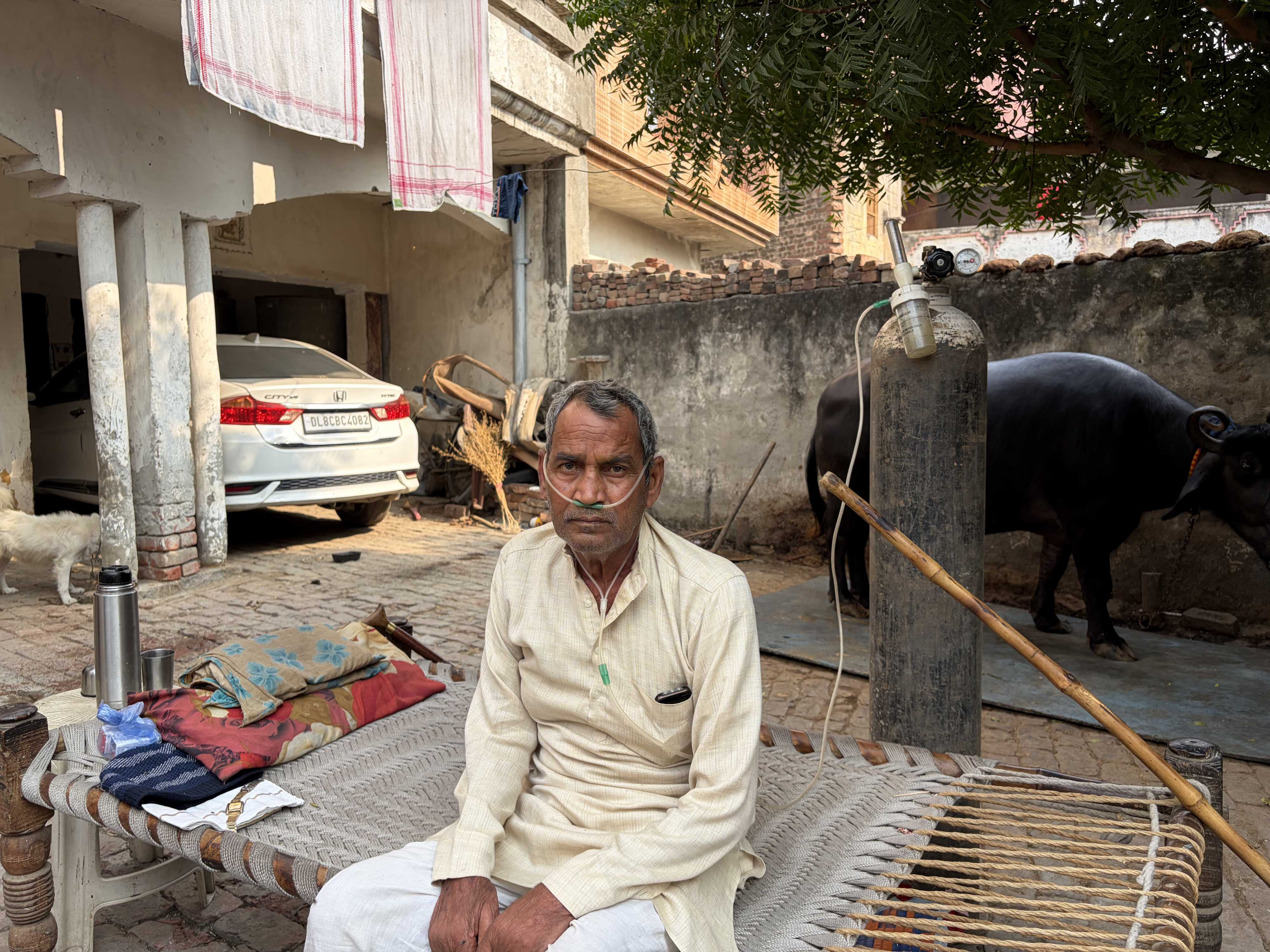
Some Loni residents survive on oxygen cylinders
Inside The World's Most Polluted City
The first thing that strikes you in Loni is the sheer density of pollution sources. Trucks move through narrow, congested streets, sending clouds of road dust into the air. Broken and unpaved stretches make matters worse. Small-scale industries operate close to residential settlements, while brick kilns add to the emissions.
There are also concerns about waste disposal and garbage discharge around the Tronica City industrial area. Residents complain about the pollution from industrial activity and the disposal of waste in their surroundings.
Loni has a large concentration of small and medium industrial units, including those involved in plastics, garments, leather, automobile components, electronics and other manufacturing activities. We also were told about unauthorised industrial operations, e-waste processing and the burning of plastic and mixed waste to recover metals.
The pollution here is a cocktail.
It is from multiple directions: industrial emissions, diesel trucks, generator sets, brick kilns, construction activity and road dust. Add to this the pollution drifting across the wider Delhi-NCR region, and the result is an environment under constant pressure. The problem is compounded during winter, when weather conditions can trap pollutants closer to the ground and slow their dispersal.
READ | Blog | I Got Lung Cancer At 35 Without Ever Smoking. Why Breathing Delhi's Air Is Not A Flex
A Living Hell For Residents
Among the people we met was Sadanand. His wife is battling cancer. As he spoke about her illness and the ordeal his family is going through, he described life in Loni as a living hell. His story brought home the human dimension of this pollution crisis. While his wife fights a serious illness, the family continues to live in an environment surrounded by dust, smoke and industrial emissions.
For Sadanand, pollution is not an abstract debate about air-quality readings. It is part of the anxiety of everyday life.
Not too far away from Sadanand's house was Hemchand's. A first stage lung cancer survivor, Hemchand told us that his doctor had advised him to leave Loni. "How can I leave this place? I not Tata Birla, I don't have financial backing. I have to live and die here.. " he told NDTV.
The diagnosis is another deeply distressing human story from this neighbourhood. It is important not to assume that local air pollution caused an individual patient's cancer without medical evidence, but the residents' concerns about prolonged exposure to polluted air deserve serious attention.
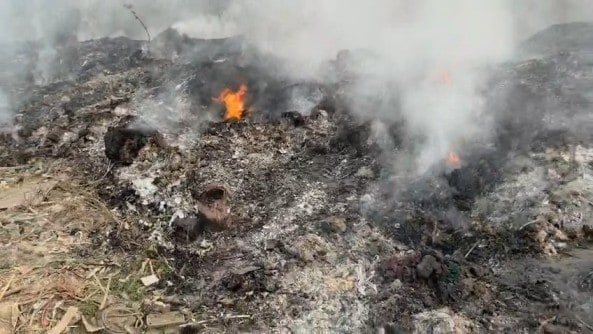
Open burning of waste has deepened this crisis
When Breathing Becomes A Struggle
Another encounter that stayed with us was with a resident who depends on an oxygen cylinder. Sohraj Singh was also diagnosed with cancer. We saw him sitting at the porch of his house, his face firmly connected to an oxygen cylinder.
This was a sight that summed up Loni for us. "My cancer is under control, but my breathing difficulties are not," Sohraj said. For someone already struggling with respiratory health, living amid dust, vehicle exhaust and industrial emissions presents an additional challenge.
These are the people behind the pollution statistics. Their lives cannot be captured by an AQI reading alone.
Even The Roadside Vendors Cannot Escape
We also spoke to people selling food along Loni's roads. Their complaints were immediate: dust, smoke, exhaust fumes and the constant movement of vehicles.
On our way back, I spotted these dhaba wallas selling food by the roadside. The vessels were covered with big aluminium plates, laden with dust. I wondered who would want to eat the food they were selling by the roadside.
Their stalls are located right beside busy roads. Every passing vehicle sends another cloud of dust into the air. They spend hours outdoors, preparing and selling food, with little opportunity to escape the pollution around them.
They also spoke about how the situation worsens around Diwali. Firecracker smoke adds another layer of pollution to an area already dealing with industrial emissions, brick kilns, vehicular exhaust and road dust.
I noticed their eyelashes had dust. Their hair had turned brown. My eyelashes too were dust laden , I noticed, when I got back to the car to head back to office in Noida. I could feel the dust all over me. I could feel it was inside me. My nose ears and mouth. Loni was seeing heavy construction work inspite of GRAP 3 being in place in the NCR (that prohibits construction activity).
For these vendors, avoiding exposure is not a realistic option. Their livelihoods depend on staying out on the streets. They weren't wearing masks. I couldn't dream of taking off mine while I was there. What became clear during our visit was that Diwali may have aggravated Loni's pollution, but it is not the reason for the crisis.
The underlying problem is much deeper and more persistent. Industrial emissions, poorly maintained roads, heavy diesel traffic, brick kilns, waste-related pollution and construction dust continue to affect the area long after the festival is over. We went to Loni because of the alarming pollution readings recorded after Diwali. But what we encountered was a community dealing with a much larger problem. Sadanand watching his wife battle cancer. Hemchand - a lung cancer patient. Sohraj - dependent on an oxygen cylinder. Street vendors who have no choice but to work in the dust.
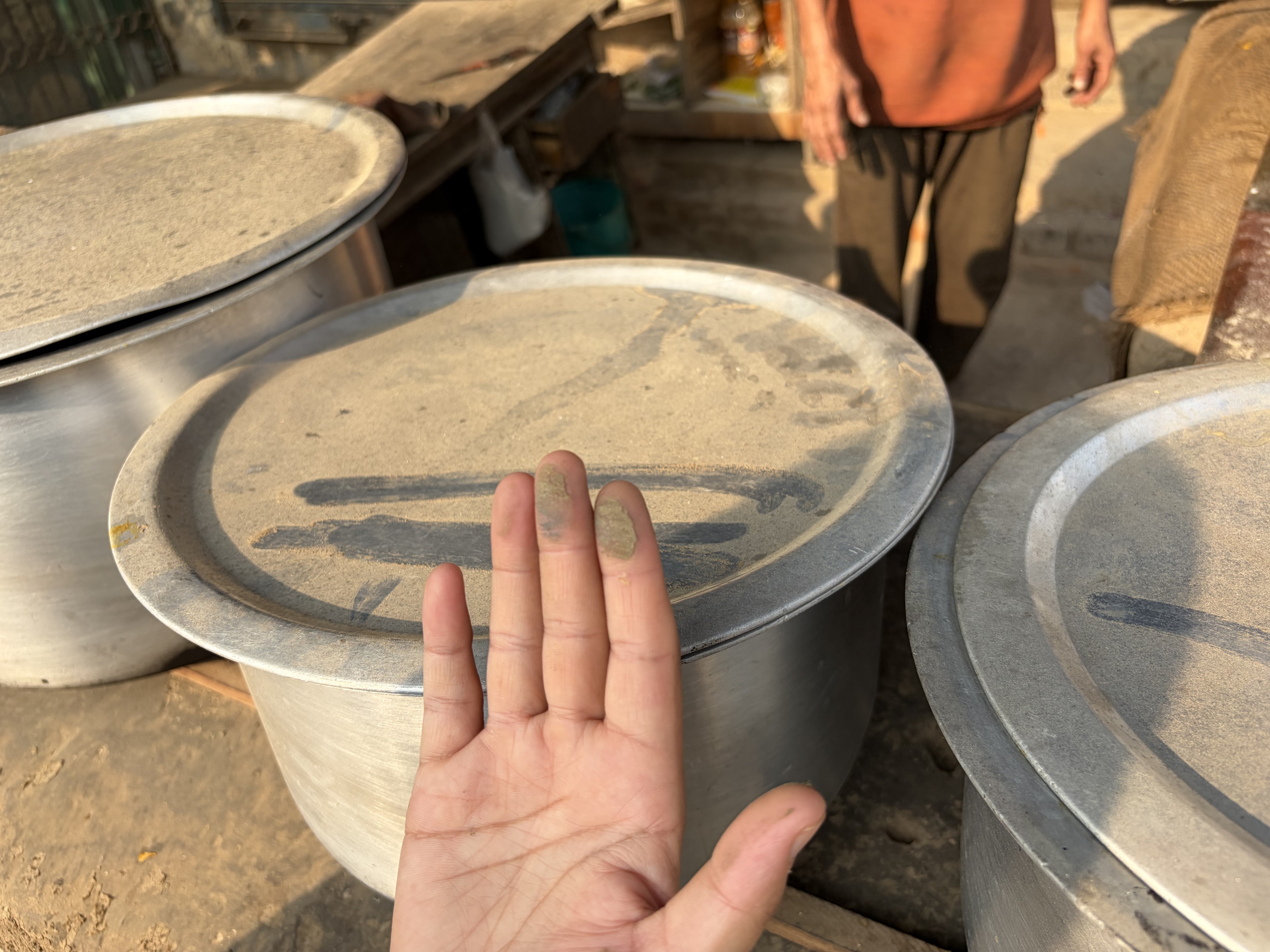
Even the roadside dhaba containers have layers of dust and soot
India's Pollution Crisis Is Much Bigger Than Delhi
Perhaps the biggest takeaway from our visit to Loni is that we need to stop looking at air pollution as a Delhi-centric problem. In fact, the 2025 IQAir World Air Quality Report tells a far more disturbing story.
Loni recorded an annual average PM2.5 concentration of 112.5 micrograms per cubic metre, higher than Delhi's 99.6. Byrnihat, a small town on the Assam-Meghalaya border, very close to my hometown of Shillong, recorded 101.1. Ghaziabad stood at 89.2, Noida at 80.5 and Greater Noida at 77.2. The problem extends further: Mullanpur Dhaka in Punjab recorded 86.2, while the Centre for Research on Energy and Clean Air (CREA) also identified Muzaffarnagar at 69, Hapur at 67, Hajipur at 71 and Bhiwadi at 74 micrograms per cubic metre.
READ | It's Not Just AQI: Why Tiny Particulate Matter Poses A Bigger Health Risk
These are annual averages, not temporary post-Diwali spikes. They reveal a much wider geographical spread of India's air pollution crisis. Smaller towns, industrial clusters and rapidly expanding urban centres are not escaping the toxic air either. In fact, 17 of the world's 20 most polluted cities in 2025 were in Central and South Asia, with India accounting for a significant share.
We went to Loni because of its alarming pollution readings after Diwali. We came back with a much bigger realisation, India's air pollution crisis is not just Delhi's problem. It is a national public-health emergency, stretching from the capital to smaller towns and cities that rarely receive the same attention.
We were there for a few hours and left with black soot on our clothes and dust in our mouths. The people of Loni do not get to leave. They wake up to this air, work in it, raise their children in it and return to homes surrounded by it.
For them, pollution is not a seasonal headline. It is everyday life.
\r\n
\r\n
Disclaimer: This content including advice provides generic information only. It is in no way a substitute for a qualified medical opinion. Always consult a specialist or your own doctor for more information. NDTV does not claim responsibility for this information.
Published: November 12, 2026 18:36 IST
also read
Delhi Air Pollution: How Long Does It Actually Take Your Lungs To Recover?
Written by Debosmita GhoshCan Pollution Affect Your Brain? The Neurological Side Of Delhi's Air Crisis
Written by Tanushka DuttaThe Economic Cost Of Toxic Air: How Pollution Impacts Workforce Productivity And Healthcare Spending
Written by Dr Sabine Kapasi
 Written by Vishesh Nagar | Thursday November 12, 2026
The ranking was led by Bulandshahr, followed by Aligarh and Faridkot, as AQI readings crossed 600 in all 10 cities.
- Written by Debosmita Ghosh | Thursday November 12, 2026
There is no single recovery time for everyone. It depends on how much pollution a person was exposed to and whether the exposure was brief or repeated.
- Written by Vishesh Nagar | Thursday November 12, 2026
The national capital's AQI was above 600, significantly higher than the readings recorded in Mumbai, Kolkata, Chennai, Hyderabad and Bengaluru.
- Written by Sneha Mordani | Thursday November 12, 2026
Worse than Delhi, Loni is the world's most polluted city. Beyond Diwali, illegal kilns, dust, and toxic waste make every breath a daily battle.
- Written by Tanushka Dutta | Thursday November 12, 2026
Studies have linked long-term exposure to particulate matter, particularly PM2.5, with changes in brain structure, accelerated brain ageing and a higher risk of dementia.

................................ Advertisement ................................
Opinion | Delhi Has Every Pollution Control Policy - Except One That Works
Monday November 09, 2026Every November, Delhi performs the same ritual. We check the AQI before stepping outdoors, children are kept indoors, masks reappear, schools consider shutting, construction is restricted, and emergency meetings are convened. Politicians blame the weather, neighbouring states, farmers, or firecrackers. And then, as the season changes, the urgency d...
दीवाली की चौखट पर दिल्ली में सांसों का संकट: 30 साल की स्टडी ने हरियाली को लेकर क्या बताया?
Thursday November 05, 2026अध्ययन में हरियाली की मात्रा के साथ उसके फैलाव और आपसी जुड़ाव को भी महत्वपूर्ण पाया गया. जिन इलाकों में हरियाली ज्यादा बिखरी हुई थी, वहां सतही तापमान अधिक रहा. इसके विपरीत, बड़े और आपस में जुड़े हरित क्षेत्रों में तापमान कम पाया गया.
Opinion: Why Delhi's Smog Can't Be Fixed From SpaceDavid Fickling, Bloomberg
Monday October 19, 2026The clearest sign that Delhi is on a path to cleaner air would be a decline in the amount of paddy grown nearby, and therefore the acreage liable to be burned each year.
Don't Normalise Air Purifiers As Delhi Chokes | The Reason Why
Thursday December 11, 2025More than 90 cities in the world's top 100 polluting list are in India. With every passing year, the AQI is rising, reaching 'hazardous' levels.
Blog | Well Done, Delhi. You've Turned Lung Sacrifice Into A Badge Of HonourSaikat Kumar Bose
Monday November 10, 2025Till some years back, Delhiites would ask angry questions to those in power about the capitals annual tryst with toxic air. This has changed. Those in the driving seat dont see the need to answer now.



