


- Home/
- From Homes To Businesses: USHA Transforming Lives In Rural Odisha
From Homes To Businesses: USHA Transforming Lives In Rural Odisha
Team NDTV | Updated: February 17, 2025 16:49 IST
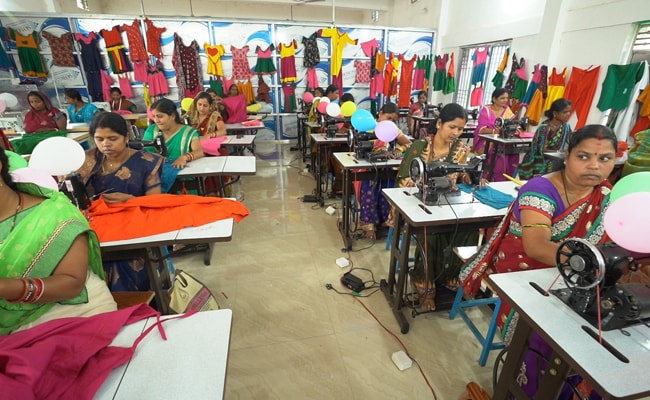
In the tribal belt of Telkoi block in Jagmohanpur district, Odisha, women are weaving not just garments but also their futures. A noteworthy example is Swain, a 33-year-old woman who travels over six kilometers daily to attend a training-cum-production center established by the Odisha Rural Development and Marketing Society (ORMAS). This initiative aims to empower women through skill development and entrepreneurship, in collaboration with Mission Shakti and the USHA Silai School program.
Swain is one of the 30 women working at the production unit specializing in crafting garments primarily for government orders. With dedicated master trainers from the USHA Silai School providing hands-on training, these women learn invaluable skills essential for their livelihoods.
Swain said,
"I had learned a little at home, mainly how to make blouses and dresses. However, after the trainer arrived, I learned comprehensive techniques. I gained knowledge in making blouses, dresses, shirts, pants, kurtis, cushion covers, and school dresses. I love coming here; I've developed a solid understanding of sewing and now know many options."
Empowering Women In The Snow-Capped Mountains: USHA Silai School's Impact In Kargil
The USHA Silai School program has been instrumental in providing tailoring skills to women in Odisha's Bhadrak and Keonjhar districts. It aims to support producer groups like the one in Jagmohanpur by securing government orders and creating mass production avenues. This initiative addresses the pressing need for employment opportunities in tribal regions where livelihood options have traditionally revolved around mining, agriculture, or processing industries.
Shri Kumar Nagabhusan, Chief Development Officer and Executive Officer of Zila Parishad, Keonjhar, said,
"In the tribal belt, many women are eager to engage in activities like sewing, which aligns with their household chores and requires no formal education. While we have ten different activities planned in the industrial park, sewing has been a game-changer, especially when women participate in large numbers. They can work during their free time without adding pressure to their family lives."
Kuni Rani Khuntiya, another participant, learned about the ORMAS and USHA training programs during a self-help group meeting in her village. Realizing she needed to step out and acquire new skills to earn a personal income, she decided to take the plunge.
She said,
"After completing my household chores by 9 AM, I arrive at the training center by 10 and train until 2 PM. In just one month, I've learned a lot. Previously, I couldn't earn much sewing blouses at home, but now, thanks to ORMAS, I can earn 3,000 to 4,000 rupees from sewing and manage my own expenses. I no longer rely on anyone at home."
The USHA Silai School program carefully selects women from self-help groups across villages for a month-long advanced tailoring training. This training raises their skill levels and prepares them to join producer groups, enhancing both productivity and economic viability.
Bijayananda Dash, Programme Coordinator for Odisha, describes how the USHA models empower women,
The Story Of USHA Silai Schools In Jammu And Kashmir
"Many women prefer to set up businesses at home rather than travel far, so we provide training to help them establish small units. With government support for product creation, they benefit from a corpus fund for raw materials. We facilitate group formation to promote a collective approach, and our work models are designed to accommodate their time constraints, recognizing their home responsibilities."
Finding employment that promotes financial independence is crucial for women in rural areas, enabling them to contribute meaningfully to household income and be active participants in the growth and development of their villages, districts, and state. The stories of women like Swain and Kuni highlight the transformative role of USHA Silai Schools. These programs equip women with essential sewing and entrepreneurial skills, opening new avenues for empowerment and societal change. As these women embrace their newfound skills, they are not just redefining their own lives but also fostering growth for their families and communities.
Published: February 14, 2025 11:03 IST
also read
Despite Nationwide Lockdown, People Employed In Health And Financial Sector Continue To Provide Services
Written by Ambika Singh KahmaHow Police Officers Are Battling The Crisis Of Coronavirus And Going Beyond The Call Of Duty
Written by Ambika Singh Kahma28-Year-Old From UP Donates Disability Pension Money To COVID-19 Fund, Urges Others To Help The Cause
PTI
 NDTV News Desk | Thursday April 02, 2020
Prime Minister Narendra Modi today announced a total lockdown in India from midnight for 21 days to fight the spread of coronavirus.
- NDTV News Desk | Friday April 03, 2020
India must also straight away allow internationally-recognized testing kits to be used here - these are already in use in the USA and Europe (do not delay by waiting for Indian clearance).
- Written by Garima Arora | Sunday April 12, 2020
Coronavirus outbreak: Take necessary precautions. Practise personal hygiene and social isolation. Utilise this time to do all the things you never found the time to do earlier. Here are some more tips to maintain your mental health by Psychiatrist Dr Sanjay Chugh
- NDTV News Desk | Thursday April 02, 2020
Hopefully, you are following social distancing and not mingling, especially with large groups or in crowded places. Can wearing a mask help? Here's what doctors say:
- NDTV News Desk | Thursday April 02, 2020
People across the world are worried about the rising cases of COVID-19, a highly contagious disease caused by the Novel Coronavirus that was first detected in China's Wuhan in December last year. What should you do if you're feeling any little ill, flu-ish and you are worried that you have symptoms of coronavirus?
- Edited by Deepshikha Ghosh | Thursday April 02, 2020
Coronavirus India: Airlines have been asked to ensure distance at check-in counters and enough space as passengers wait for their flights


